Ngorongoro Expedition and Tours

Great Wildebeest Migration

Complete Guide to the Great Wildebeest Migration in Serengeti

What Is the Great Wildebeest Migration? 

The Great Wildebeest Migration is one of the most breathtaking natural events on the planet a year-round movement of over 1.5 million Wildebeest, along with vast herds of Zebras, across the sweeping Serengeti ecosystem in Tanzania. Driven by the instinct to find fresh grazing lands and water, this endless journey showcases the very heart of Africa’s wild beauty and resilience. 

Far more than a migration, it is a powerful story of life, death, and renewal, unfolding across the open plains under the African sun. Each year, the herds follow an ancient, circular route through the Serengeti National Park, the Ngorongoro Conservation Area, and into Kenya’s Masai Mara, creating a living rhythm of movement that sustains the entire ecosystem. 

From the calving season in Ndutu where thousands of newborn wildebeest take their first steps to the thrilling Mara River crossings filled with danger and determination, every stage of the journey offers an unforgettable glimpse into nature’s raw power. Witnessing this spectacle up close is more than a safari; it’s an encounter with one of Earth’s most extraordinary wildlife events.

In this complete guide by Ngorongoro Expedition & Tours, you’ll discover:

  • What the Great Migration is and why it happens.
  • When and where to see it throughout the year.
  • Expert travel tips for maximizing your safari adventure.

Whether you’re planning a once-in-a-lifetime safari, a luxury safari, or a photography safari, this guide will help you understand every aspect of the Great Wildebeest Migration in Tanzania and how to witness it at its most breathtaking moments.

What Is the Great Wildebeest Migration?

The Great Wildebeest Migration is one of the most breathtaking natural events on the planet a year-round movement of over 1.5 million Wildebeest, along with vast herds of Zebras, across the sweeping Serengeti ecosystem in Tanzania. Driven by the instinct to find fresh grazing lands and water, this endless journey showcases the very heart of Africa’s wild beauty and resilience. Far more than a migration, it is a powerful story of life, death, and renewal, unfolding across the open plains under the African sun. 

Each year, the herds follow an ancient, circular route through the Serengeti National Park, the Ngorongoro Conservation Area, and into Kenya’s Masai Mara, creating a living rhythm of movement that sustains the entire ecosystem. From the calving season in Ndutu where thousands of newborn wildebeest take their first steps to the thrilling Mara River crossings filled with danger and determination, every stage of the journey offers an unforgettable glimpse into nature’s raw power. Witnessing this spectacle up close is more than a safari; it’s an encounter with one of Earth’s most extraordinary wildlife events.

In this complete guide by Ngorongoro Expedition & Tours, you’ll discover:

  • What the Great Migration is and why it happens.
  • When and where to see it throughout the year.
  • Expert travel tips for maximizing your safari adventure.

Whether you’re planning a once-in-a-lifetime safari, a luxury safari, or a photography safari, this guide will help you understand every aspect of the Great Wildebeest Migration in Tanzania and how to witness it at its most breathtaking moments.

Great Wildebeest Migration

Why Great Wildebeest Migration Happens.

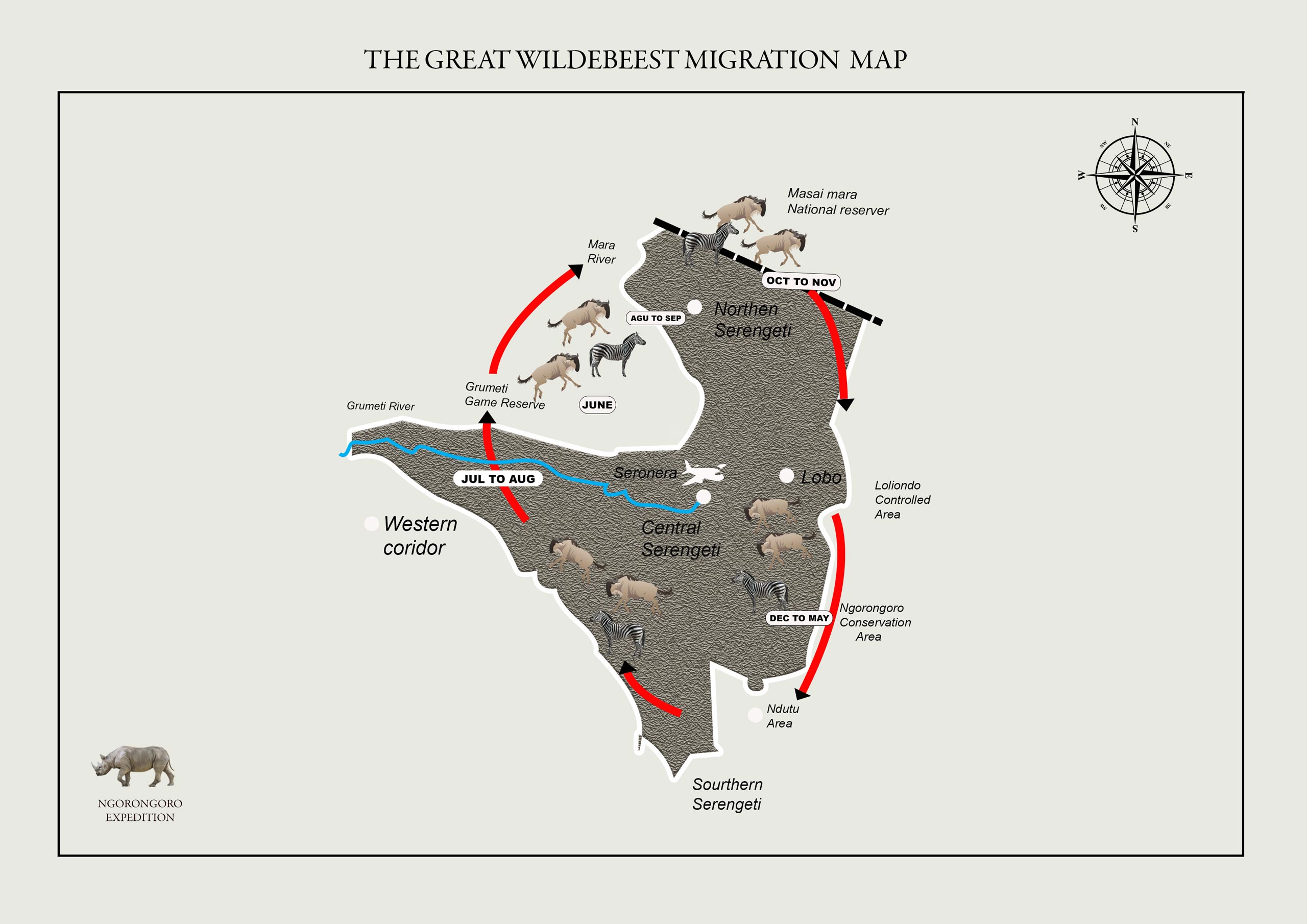
The Great Wildebeest Migration takes place because these animals must keep moving in order to survive. Wildebeest, together with Zebras, travel in massive groups across the Serengeti to Masai Mara ecosystem in search of fresh grazing areas, reliable water sources, and safe places to give birth. Rain in East Africa does not fall in one fixed area it shifts from one region to another throughout the year. This change in rainfall causes some places to become green and fertile while others dry out, forcing the animals to relocate again and again in response to the seasons.

Driven by instinct, the herds follow the rains along a circular path of roughly 1,800 miles (2,900 km) each year. The cycle typically starts in January and February when more than 500,000 calves are born in the nutrient-rich Ndutu plains of southern Serengeti. The green grass there enables mothers to produce enough milk and gives newborns a stronger chance of survival. But once the dry season begins and the grass disappears, the long journey resumes.

From March to June, the herds move northwest, crossing rivers and facing predators along the way. By July to September, they arrive at the Grumeti and Mara rivers, where one of the most dramatic scenes in nature unfolds: the river crossings. During this stage, thousands of wildebeest and zebras attempt to swim through strong currents while crocodiles wait in the water below. Many are lost, but those that survive reach the greener grasslands of Kenya’s Masai Mara.

When the short rains return around October and November, the animals begin to head south again toward the Serengeti, restarting the entire cycle. This constant movement is not optional it is essential for survival. If the herds stayed in one place, they would run out of food and water. By migrating with the rains, they gain access to fresh, nutrient-rich grasses that not only nourish them but also support the health and balance of the Serengeti ecosystem. Their continuous grazing fertilizes the land, helping new vegetation grow and sustaining other wildlife.

The Great Migration is more than a journey it is the driving force that keeps the ecosystem functioning. It is a living example of natural endurance and a powerful force that has shaped East Africa’s savannas for centuries. Watching millions of animals move across the plains, seeing predators hunt, and witnessing newborn calves stand for the first time is more than a safari it is an encounter with nature in its purest form and a reminder of how strong, wild, and beautiful the natural world truly is.

Great Wildebeest Migration

Best Time to Watch the Great Wildebeest Migration.

The Great Wildebeest Migration in Tanzania is not a single-day or single-location spectacle it is a continuous, year-round ecological cycle that shifts across the vast Serengeti ecosystem. Every month offers a different phase of the migration, from mass birthing to lethal river crossings. The “best time” depends entirely on what part of the migration you want to witness calving, crossings, or predator encounters. Tanzania hosts the largest portion of the migration before the herds cross to Kenya, making it the top destination to experience this natural wonder.

January – March: Calving Season in Southern Serengeti (Ndutu & Kusini Plains)

This period is ideal for travelers who want to experience life and death at close range. The lush volcanic soil of Ndutu provides rich grass, attracting heavily pregnant wildebeest. Between late January and February, over 500,000 calves are born in just 2–3 weeks, creating a newborn explosion across the open plains.

With this abundance comes danger lions, cheetahs, hyenas, jackals, and leopards patrol the area in search of easy prey. The flat, open landscape makes sightings easy, and photographers capture some of the most raw wildlife action during this time. The weather is warm with light rains, and travel conditions remain accessible.

April – May: The Herds Push North Through Central Serengeti

As the long rains progress, lush grazing areas shift, and the herds begin their slow, coordinated trek northward. Central Serengeti (Seronera) becomes a corridor of movement endless lines of wildebeest and zebra stretch to the horizon. This shoulder season offers several advantages:

  • fewer tourists for quieter safari experiences
  • lower lodge and camp prices
  • dramatic skies and lush green landscapes

Although this phase lacks river crossings, it provides sweeping views of large-scale migration with minimal crowds.

June – July: Western Serengeti & Grumeti River Crossings

By June, the herds reach the Western Corridor, where the first major river challenge begins the Grumeti River. Massive Nile crocodiles wait beneath the surface as the first wildebeest attempt the crossings. This season offers intense viewing without the extreme crowds of the Mara River months.

Dry season weather begins, making it perfect for game drives, walking safaris, and hot-air balloon flights. If you want to witness dramatic crossings without peak-season congestion, this is an excellent choice.

August – October: Iconic Mara River Crossings in Northern Serengeti

This is the most famous and most photographed phase of the Great Migration in Tanzania. The herds converge in Kogatende, Lamai, and Mara River zones, where they repeatedly cross and recross the treacherous Mara River a chaotic scene of panic, stampedes, drowning, and predator attacks.

River crossings here are considered one of the Seven Natural Wonders of Africa, drawing filmmakers, wildlife photographers, and safari enthusiasts from around the world. Weather is dry and clear, and wildlife concentrations are exceptionally high.

November – December: The Return South towards Serengeti Calving Grounds

With the arrival of short rains, the ecosystem “resets” as grasses regenerate further south. The massive herds begin their long return journey, gradually spreading across eastern and southern Serengeti as they head back to Ndutu for another calving cycle.

Great Wildebeest Migration
Serengeti Great Migration Map

Where to Stay During the Great Wildebeest Migration in Tanzania

Witnessing the Great Wildebeest Migration in Tanzania is a once-in-a-lifetime safari experience. Selecting the right accommodation ensures comfort, exclusive wildlife access, and an authentic Serengeti adventure. Tanzania offers luxury safari lodges, boutique tented camps, and premium mid-range options near key migration hotspots.

Southern Serengeti (January–March) – Calving Season

The southern Serengeti is the perfect destination for witnessing wildebeest calving. Top accommodations include:

  • Ndutu Lodge – A premium lodge located near the calving grounds, offering comfortable rooms, guided game drives, and easy access to wildlife-rich areas.
  • Lake Ndutu Tented Camp – A luxurious tented camp with spacious tents, private verandas, and breathtaking views of the southern plains.
  • Serengeti Pioneer Camp – A high-end seasonal camp for wildlife enthusiasts seeking an immersive safari experience during the calving season.

Western Serengeti (May–July) – Migration Path

As the herds traverse the western corridor, these lodges offer luxury and exclusive game-viewing:

  • Grumeti Hills Lodge – Luxury lodge perched on a scenic hill with panoramic views over the Grumeti River and surrounding savannah.
  • Singita Sabora Tented Camp – Ultra-luxury camp featuring spacious tents, private decks, and curated wildlife experiences.
  • Mbalageti Luxury Safari Lodge – Premium lodge combining comfort, excellent service, and proximity to the western migration route.

Northern Serengeti (July–October) – Mara River Crossings

The northern Serengeti is famed for dramatic Mara River crossings and predator activity:

  • Sayari Camp – Remote luxury camp with spacious tents, personalized guides, and river-view locations ideal for photography.
  • Serengeti Bushtops Luxury Tented Camp – High-end tented camp offering panoramic views, private plunge pools, and exclusive wildlife excursions.
  • Lemala Kuria Hills Lodge – Boutique lodge perched on scenic hills overlooking the Mara River, perfect for capturing the migration on camera.
  • Mara River Camp – Premium camp with tents positioned right by the river for front-row views of crossing wildebeest and predator hunts.

Central Serengeti (November–December) – Plains Rejuvenation

When the herds return to the central Serengeti, these lodges provide prime access and luxury comfort:

  • Four Seasons Safari Lodge Serengeti – A world-class luxury lodge with private pools, panoramic game-viewing terraces, and tailored safari experiences.
  • Seronera Wildlife Lodge – Centrally located lodge with direct access to prime wildlife areas, ideal for game drives.
  • Dunia Camp – Boutique camp offering luxury tents, intimate wildlife encounters, and personalized service.
  • Kubu Kubu Tented Camp – Modern luxury camp with spacious tents, stunning views, and an emphasis on exclusive safari experiences.
 
The Great Wildebeest Migration – Month by Month
Month Location What Happens
January Ndutu & Southern Serengeti Calving season begins on the Ndutu plains. Thousands of newborn calves attract predators, creating intense yet photogenic wildlife action
February Ndutu & Southern Serengeti Peak calving continues as more than 400,000 calves are born. The short-grass plains provide rich grazing and excellent predator sightings
March Ndutu & Southern Serengeti Herds remain in the Ndutu region, feeding on nutrient-rich grass before preparing to move north. Predator encounters are frequent
April Central Serengeti As rains increase, herds begin migrating toward the Seronera Valley. The landscape turns lush, offering quiet but rewarding game viewing
May Central & Western Serengeti Movements intensify as wildebeest push toward the Western Corridor. The ecosystem becomes green and vibrant after the long rains
June Western & Central Serengeti Herds reach the Grumeti River, facing their first major water crossings. Large crocodiles create dramatic and action-filled scenes
July Western & Northern Serengeti / Masai Mara The migration builds toward the Mara River. Large herds gather along the riverbanks, preparing for the iconic crossings.
August Masai Mara & Northern Serengeti Peak Mara River crossing season. Thousands of wildebeest plunge into crocodile-filled waters, offering the most dramatic migration moments
September Masai Mara & Northern Serengeti Herds spread out across Lamai and Kogatende, with continued river crossings and excellent predator sightings
October Northern Serengeti & Masai Mara The plains remain rich with grazing as herds slowly prepare for their southward journey. Big cat sightings are exceptional
November Northern Serengeti & Ngorongoro Conservation Area Short rains begin, triggering the southward return toward the Ndutu region. Movements are scattered but predictable
December Ngorongoro Conservation Area & Southern Serengeti Herds settle on the short-grass plains of Ndutu, the perfect environment for the upcoming calving season. The cycle prepares to start again

BEST TIME TO VISIT GREAT WILDEBEEST MIGATION

  • December to March: Calving season is the ideal time to witness the birth of thousands of young animals. It’s also when predators are most active, hunting vulnerable newborns.

  • April to June: The migration begins, as large herds of wildebeest, zebras, and other species start moving northward across the Serengeti in search of fresh grazing lands.

  • July to October: Peak migration season, especially notable for the dramatic and dangerous crossings of the Mara River, where many animals fall prey to crocodiles.

  • November: Short rains signal the return of the herds to the Serengeti after months away, revitalizing the landscape and offering another spectacular wildlife display.

HOW TO GET there

  • By Road: The Serengeti is accessible by a roughly 7-hour scenic drive from Arusha, allowing travelers to pass through various landscapes, including villages and countryside along the way. It’s a great option for those who enjoy road trips and want to see more of the Tanzanian landscape before arriving at the park.

  • By Air: For a faster, more convenient option, regular flights operate from Arusha to multiple airstrips within the Serengeti. These flights significantly reduce travel time, offering stunning aerial views of Tanzania’s wildlife and landscapes.

TIPS FOR VISITORS TO WHo wants to see wildebeest migration

  • Pack Smart: Bring lightweight, comfortable clothing suitable for varying temperatures, along with a hat, sunscreen, and insect repellent.
  • Stay Hydrated: Make sure to carry plenty of water, especially during extended game drives to stay refreshed.
  • Respect Wildlife: Always observe animals from a safe distance and avoid interacting with or feeding them.
  • Follow the Rules: Listen carefully to your guide and follow all park regulations for both your safety and the preservation of the environment.

FAQ About the Great Wildebeest Migration

1) What is the Great Wildebeest Migration in Tanzania?

The Great Wildebeest Migration is a yearly wildlife movement where enormous herds of wildebeest, along with zebras and gazelles, travel across the Serengeti in search of water and fresh grazing land. It is one of the most extraordinary natural events on the planet.

2) When is the best time to watch the Great Wildebeest Migration in Tanzania?

The best time depends on the stage you want to see:

  • January–March: Calving season in the Ndutu and southern Serengeti plains
  • June–July: Grumeti River crossings in the western Serengeti
  • August–October: Mara River crossings in the far north of the Serengeti

3) Where is the migration best seen inside Tanzania?

Popular viewing areas include the Ndutu region, Central Serengeti around Seronera, the Western Corridor near the Grumeti River, and Kogatende/Lamai in the north of Serengeti National Park.

4) What causes the Wildebeest Migration to occur?

This movement is driven by seasonal changes in rainfall. As new grass grows with the rains, the herds follow it to feed, give birth, and survive during dry periods.

5) Does the migration happen every year without fail?

Yes, it occurs every year as part of nature’s cycle. However, the specific timing and herd positions may shift depending on where the rain falls and how quickly grass grows.

6) When do herds cross the Mara River in Tanzania?

The river crossings in the northern Serengeti generally occur from August to October, before the animals move into Kenya’s Masai Mara.

7) Can predators be seen during the Great Wildebeest Migration?

Absolutely. Lions, hyenas, cheetahs, leopards, and large crocodiles often target the migrating animals especially during calving and at river crossing points.

8) Is Tanzania or Kenya better for viewing the Great Wildebeest Migration?

Many travelers choose Tanzania because about four-fifths of the entire migration route takes place there, including key events like calving and major river crossings before reaching Kenya.

9) What kind of safari setup is best for viewing the Great Wildebeest Migration?

Top choices include mobile camps located near the herds, guided 4×4 wildlife drives in the Serengeti, and hot-air balloon safaris for a high-level view of the action.

10) How early should I plan and book a Great Wildebeest Migration safari?

During high-demand months like January–March and June–October, it is wise to make reservations 6 to 12 months before travel, as camps and balloon seats get booked early

Animals in Serengeti National Park

Elephant

Giraffe

Hippo

Buffalo

Leopard

Wildebeest

Wild Dog

White Rhino

Black Rhino

Cheetah