
Mount Meru is Tanzania’s second-highest mountain, rising 4,566 meters (14,980 ft) above sea level. Located within Arusha National Park, this spectacular stratovolcano offers dramatic crater cliffs, diverse wildlife, and one of the most scenic trekking experiences in Africa. Often overshadowed by nearby Mount Kilimanjaro, Mount Meru is widely regarded by experienced climbers as more adventurous, less crowded, and incredibly rewarding. The mountain’s narrow summit ridge, volcanic ash cone, and sweeping views of Kilimanjaro at sunrise create an unforgettable high-altitude experience. Unlike many major trekking peaks, Mount Meru begins in a rich savannah habitat. Climbers may encounter giraffes, zebras, buffalo, and colobus monkeys on the lower slopes, making it one of the few mountains in the world where your ascent starts like a safari. With a well-paced 3–4 day itinerary, excellent acclimatization profile, and breathtaking scenery throughout, Mount Meru is not just a preparation climb for Kilimanjaro; it is a world-class trekking destination in its own right. For adventurers seeking beauty, challenge, wildlife, and fewer crowds, Mount Meru truly is Africa’s hidden gem. WHY CLIMB WITH NGORONGORO EXPEDITION AND TOURS Our Heritage & Expertise – Following the Legacy of Mzee Yohane Lawuo Our expertise is not just professional; it is inherited. We proudly carry the mountaineering legacy of Yohane Lawuo (Mzee Yohane Lawuo), the Chagga guide widely recognized as the first African and one of the first men to reach the summit of Mount Kilimanjaro in 1889 alongside Hans Meyer. Mountaineering runs in our blood, passed down through generations of experience, resilience, and deep respect for the mountain environment. We have inherited profound mountain knowledge, traditional Chagga high-altitude survival skills, indigenous weather-reading techniques, strong safety leadership, and a rich cultural understanding of Tanzania’s peaks. This heritage gives us unmatched local expertise when guiding climbers on Mount Meru and Mount Kilimanjaro. We do not just guide mountains, we continue a family tradition of excellence, responsibility, and pride. WHERE IS MOUNT MERU LOCATED ? Mount Meru is located in northern Tanzania, approximately 70 km west of Mount Kilimanjaro and just outside the vibrant safari hub city of Arusha. The mountain rises prominently above the surrounding plains, forming a dramatic backdrop to Arusha and serving as one of the most striking natural landmarks in the region. Mount Meru lies within Arusha National Park, a protected conservation area known for its diverse ecosystems, including open savannah, montane forest, and alpine landscapes. Because of this unique location, climbers begin their trek surrounded by wildlife such as giraffes, zebras, buffalo, and various antelope species a rare and unforgettable experience not commonly found on other major mountains around the world. The mountain’s position near the Kenyan border also places it within the eastern branch of the Great Rift Valley system, contributing to its volcanic origin and dramatic crater formation. Its accessibility from Kilimanjaro International Airport and Arusha makes it a convenient yet less crowded alternative to Mount Kilimanjaro, while still offering equally spectacular scenery and adventure. |
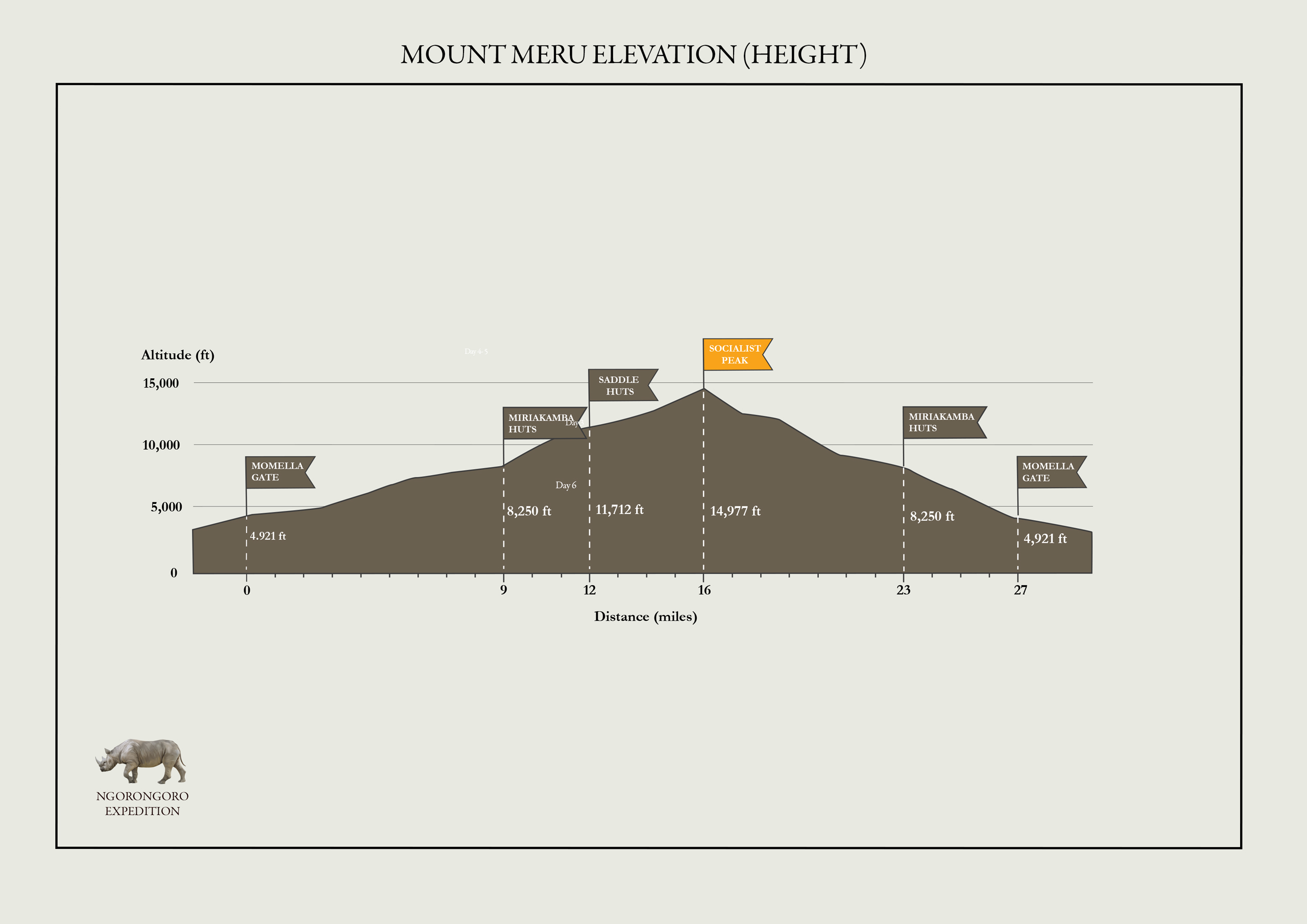
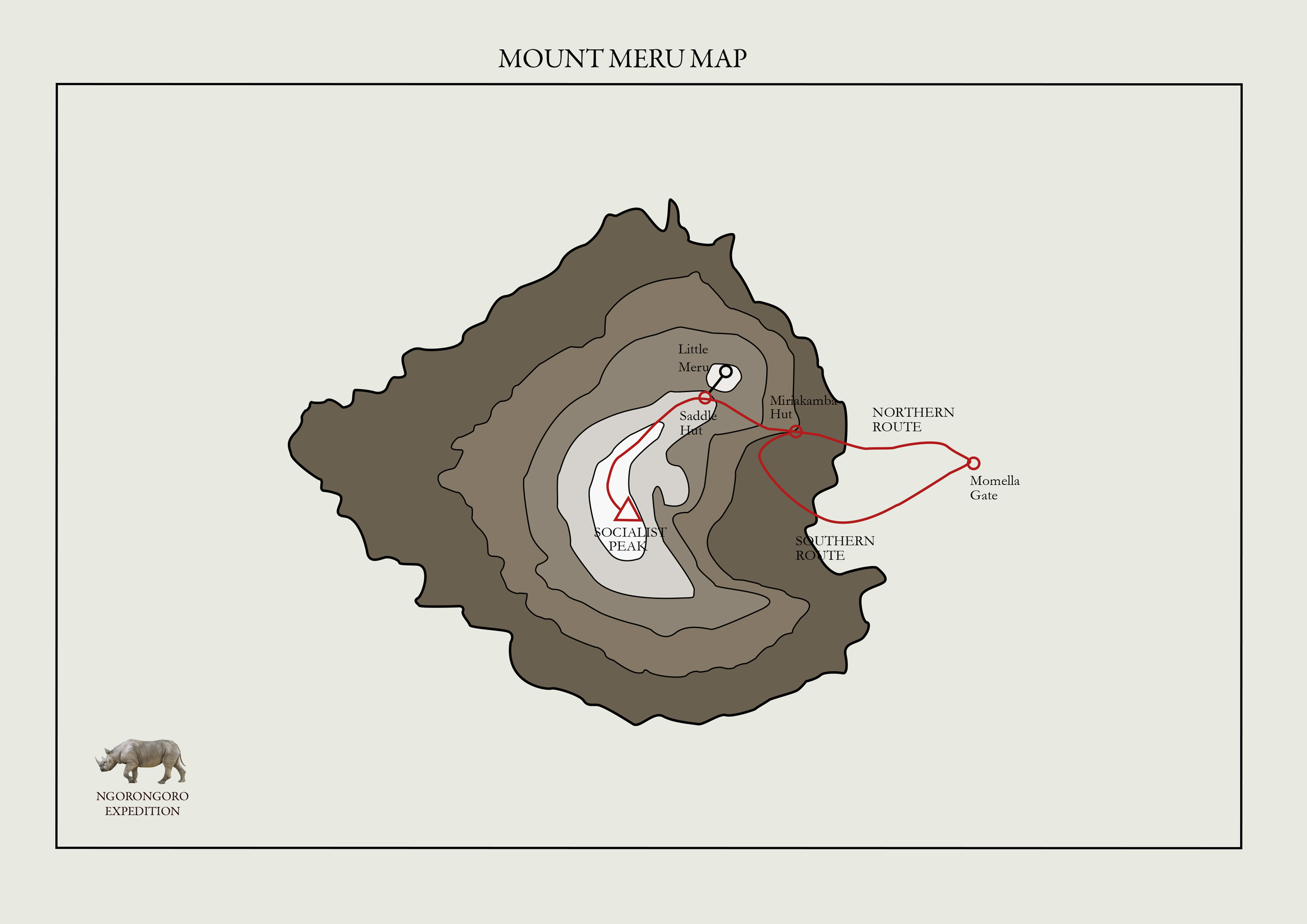
GEOLOGICAL HISTORY OF MOUNT MERU Mount Meru is an active stratovolcano that began forming over 500,000 years ago as part of the Great Rift Valley’s extensive volcanic activity. Over millennia, repeated eruptions deposited layers of lava, ash, and volcanic rock, gradually building the mountain into one of Tanzania’s most prominent peaks. Around 7,800 years ago, a massive eruption triggered the eastern flank’s collapse, forming the dramatic horseshoe-shaped crater that defines Mount Meru today. This catastrophic event reshaped the surrounding landscape, creating steep cliffs, a wide crater, and unique volcanic formations that still captivate geologists and trekkers alike. The volcano’s last minor eruption occurred in 1910, indicating that it remains geologically active, though it has been dormant for over a century. Today, climbers experience a mountain rich in volcanic history, with a 3.5 km wide crater, an inner ash cone, steep volcanic cliffs, and alpine desert landscapes near the summit, making it both a natural wonder and an adventurous trekking destination. MOUNT MERU HEIGHT AND KEY FACTS Mount Meru stands 4,566 meters (14,980 ft) tall, making it the second-highest mountain in Tanzania. Its summit, called Socialist Peak, is popular with climbers who want to see sunrise views over the landscape and clear views of Mount Kilimanjaro. Mount Meru has a prominence of 3,172 meters, giving it a dramatic presence above the plains of northern Tanzania. The standard climbing duration is 3–4 days, allowing trekkers to acclimatize gradually while enjoying the rich diversity of ecosystems along the slopes. The difficulty level is considered moderate, making it accessible for fit beginners as well as experienced climbers seeking an alternative to the more crowded Mount Kilimanjaro. One of the highlights of climbing Mount Meru, Tanzania, is the summit ridge walk. As the sun rises, climbers are treated to panoramic views that showcase the vast volcanic crater, steep cliffs, and the alpine desert near the peak. On clear days, the sight of Kilimanjaro in the distance adds an unforgettable backdrop, making the experience both challenging and immensely rewarding. CLIMBING MOUNT MERU Tanzania ROUTE & ITINERARY The most popular and official route for climbing Mount Meru is the Momella Route, widely recommended for its gradual ascent, scenic diversity, and excellent acclimatization opportunities. This route takes trekkers through a variety of stunning landscapes, beginning in open savannahs teeming with wildlife and gradually moving into dense montane forests, volcanic ash zones, and the rugged alpine desert near the summit. The Momella Route provides an ideal combination of adventure, natural beauty, and a manageable climb for those preparing for higher peaks like Mount Kilimanjaro. Standard 4-Day Itinerary Day 1: Momella Gate → Miriakamba Hut
Day 2: Miriakamba Hut → Saddle Hut
Day 3: Summit (Socialist Peak) → Return to Miriakamba
Day 4: Descent to Momella Gate
Because Mount Meru lies within Arusha National Park, all climbers must be accompanied by an armed ranger. This not only ensures safety from wildlife such as buffalo and elephants but also adds a unique safari-like experience to the beginning of the trek, making Mount Meru a truly distinctive mountain adventure. |
WILDLIFE EXPERIENCE ON MOUNT MERU Wildlife on Mount Meru is one of the most remarkable aspects of trekking this Tanzanian mountain. Located within a protected reserve, the lower slopes offer hikers the chance to encounter animals in their natural habitats, turning a climb into a mini safari.
|
